
Radical.PROTECT
The complete business continuity and protection system
For companies and public institutions that want to keep running when an incident happens: continuity, recovery, versioned backup, cybersecurity, trained people and clear processes, in a single methodology.
Security is not assumed. It is demonstrated.
The problem
Incidents stop operations because of a lack of preparation, not just a lack of technology.
Many organisations have antivirus, a firewall and backups. Yet when an incident happens, operations stop because it is unclear what must be restarted first, who decides, and whether the data can really be recovered.
Radical.PROTECT starts from this reality: technology matters, but continuity depends on preparation.
-
It is unclear who decides and what gets restarted first.
-
Backups exist, but a restore has never been tried.
-
Procedures live in a few people's heads, not on paper.
Methodology
Six stages, one outcome: a prepared organisation.
Every stage leaves verifiable measures behind, and the cycle restarts with periodic reassessment.
-
Audit
We understand where you stand today.
-
Implementation
We put the measures into practice.
-
Protection
We reduce and control the risks.
-
Recovery
We recover in a controlled way after an incident.
-
Monitoring
We watch and detect early.
-
Education
Prepared people, safer organisations.
Business Continuity
Essential operations keep going, even during an incident.
Business Continuity means knowing in advance what must keep working, how quickly and with which resources when something stops.

-
Critical functions
The activities the organisation cannot run without: invoicing, customer relations, production, payments. They are identified first and protected first.
-
RTO — how long you can be down
The maximum acceptable time before a critical function must work again. For example: invoicing must be working again the same day.
-
RPO — how much data you can afford to lose
How old the most recent recoverable data may be. If you can afford to lose at most one hour of work, copies must be made at least once an hour.
The continuity plan
A short, practical document: the critical functions, the RTO and RPO for each, who decides, which alternatives exist and how to communicate during the incident. It is tested and updated periodically.
Disaster Recovery and backup
Disaster Recovery and versioned backup
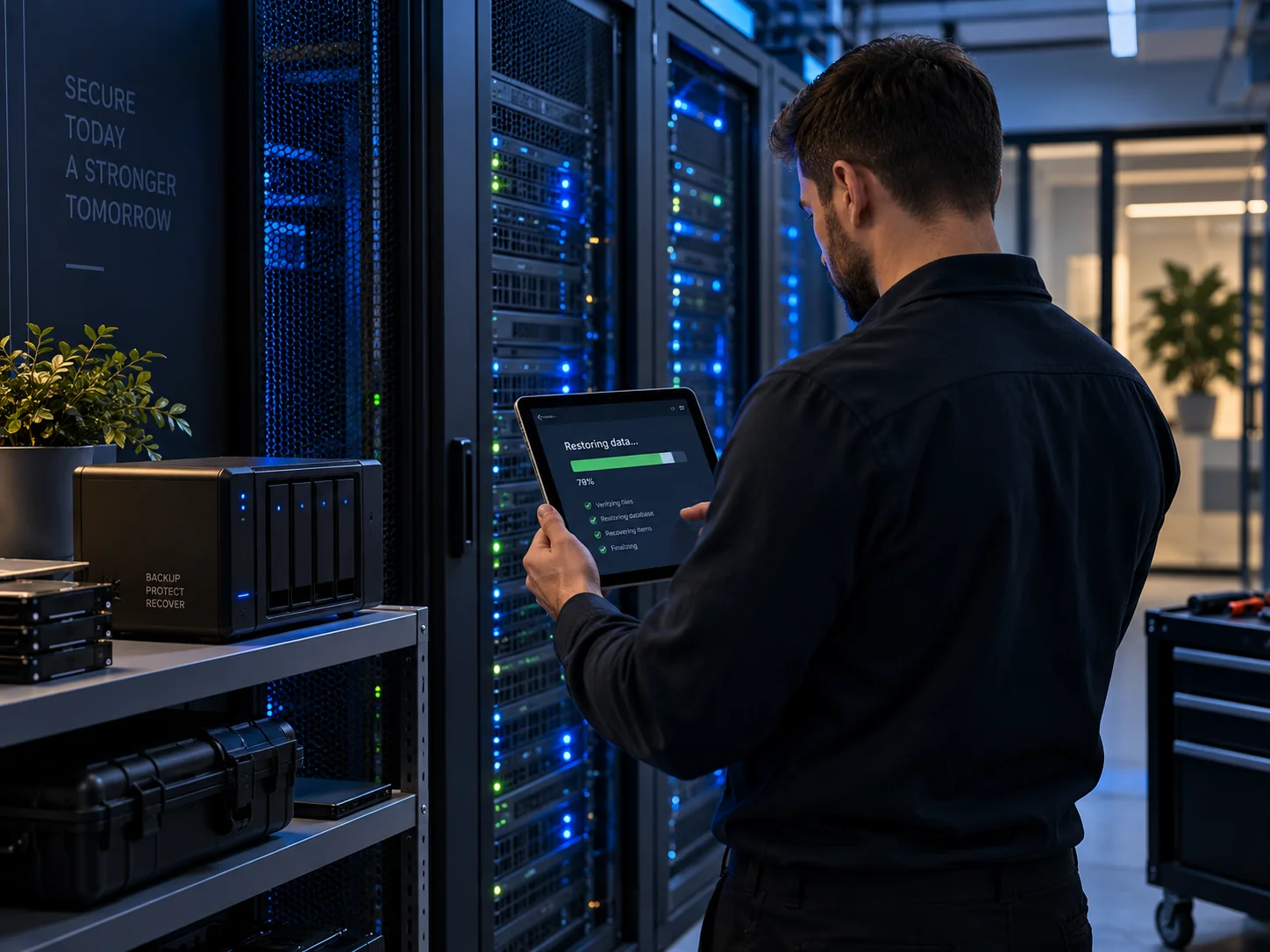
Disaster Recovery means a controlled return after an incident, following steps agreed and checked in advance, not improvised in the middle of a crisis.
-
Versioned backup
Several versions of the data are kept, so you can return to a state from before the incident, not just to the latest copy.
-
Isolated backup
At least one copy is kept apart from the working network, so an attack on the systems cannot reach the copies as well.
-
Tested by regular restores
A backup only counts if it can be restored. Restores are tried regularly, not for the first time on the day of the incident.
-
Recovery steps agreed in advance
The order in which systems are restarted, who performs each step and how the result is checked are written down before the incident.
Cybersecurity
Less risk, through verifiable measures.
Cybersecurity reduces the likelihood and the impact of an attack. It does not rely on promises, but on measures that can be checked and demonstrated at any time.
-
Controlled access
Each person has only the rights they need, and accounts are reviewed regularly.
-
Up-to-date, correctly configured systems
Known vulnerabilities are closed and insecure default settings are corrected.
-
Evidence, not assumptions
Measures are documented and checked, so the state of protection can be shown, not just claimed.
Security is not assumed. It is demonstrated.
People and processes
People, roles, processes and procedures
In an incident, people decide how quickly the organisation recovers. Technology only helps if everyone knows what to do.
-
Clear roles in a crisis
It is agreed in advance who leads the response, who communicates and who carries out the technical steps.
-
Written processes and procedures
Critical processes and key steps are documented, simple and accessible, not kept only in the memory of a few colleagues.
-
Training
Employees learn to recognise risks and react correctly, through courses suited to their role.
See Radical.PROTECT Academy courses

Radical.CORE
The software component of Radical.PROTECT
Radical.CORE is the software component of Radical.PROTECT.
Radical.CORE implements, automates, controls and helps demonstrate a large share of the Radical.PROTECT technical measures and good practices.
Radical.CORE is Radical.PROTECT, but Radical.PROTECT is more than Radical.CORE: the methodology also covers people, processes, procedures and the audit. Radical.CORE can also be purchased independently of the Professional Audit.
Radical.CORE Full — 30-day demo
The Full version, free for 30 days, once per company tax ID (CIF).
bizz.club members and companies founded less than 6 months ago can use the demo for 3 months; the extension is granted after verification.
Radical.COREAcademy
Radical.PROTECT Academy: less human risk
Many incidents start with a human action: a link clicked, a reused password, a skipped step.
In our experience, human error and lack of employee training are most often both the surest way in for cyber attackers and the most frequent cause of damage from within: data deleted by mistake, equipment damaged or lost, settings changed unintentionally.
Technology only protects as far as the people using it allow. That is why Radical.PROTECT Academy offers role-based courses for employees, technical teams and management, so everyone knows what to do and, above all, what not to do.
Audit
Audit, implementation and periodic audit
The audit stays independent: it shows the real situation and recommends only what genuinely solves the problems identified. Radical.CORE is recommended only where it addresses the measures found.
-
Free Audit
A free phone conversation of about 45 minutes about the organisation's situation.
-
Professional Audit
An analysis of continuity, backup, security and processes, with concrete recommendations.
-
Audit Implementation
Putting the recommended measures into practice, in order of priority.
-
Radical.PROTECT in operation
The measures work, are documented and can be demonstrated.
-
Periodic Audit
Regular reassessment, for new equipment and new threats, so protection keeps pace.
Why periodic audit is not optional
Infrastructure never stands still: new computers, servers, printers, applications and employees keep arriving. Every device added since the last audit remains outside the safety zone until it is checked. Threats don't stand still either: new attack methods, vulnerabilities and techniques keep emerging, and measures that were enough yesterday may be outdated today. A periodic audit brings new devices under the same protection, backup and continuity rules and checks whether existing measures still hold against current threats. Last year's protection covers neither today's infrastructure nor today's threats. That is why periodic audit is a necessity, not a luxury.
The first step is a conversation.
Book the Free Audit and find out where your organisation stands and what is worth doing first.